It seems rather odd, at least to me, that Jesus asks a rhetorical question—one that, he above everyone else—knows the answer to: Whom are you looking for?1 Jesus asks this to Judas, the Roman soldiers, and the Chief Priests’ guards who came in the midst of his prayer and the disciples’ slumber so that he may be betrayed and arrested.
The scripture tells us that it is Jesus himself who posed this question, “knowing all that was to happen to him.”2 He knew—of course he knew. And yet, he still bothered to ask. Was it out of formality? I’m not quite sure it was. You see, the text says that Jesus “came forward and asked them,” and we know that Judas and the armed men were already approaching him; it is Jesus who takes the initiative.3 In fact, not only does he ask them himself, but does so twice and provides the same answer three times: “I am he.”4 Far more than them, it was he who knew the answer.
Whom are you looking for? This question, posed at the threshold of his passion, is not new to Jesus or those who crossed paths with him. To the zealous mother of Zebedee’s sons, he asked “What is it you want?”5 To his disciples on the way to Caesarea Philippi, he asked “Who do you say that I am?”6 And here, to Judas and the armed men, he asked “Whom are you looking for?” In each of these instances, we hear Jesus calling out to those who are in pursuit of him—either as followers or detractors—and speaks directly to the longings of their hearts.
Who is it you are looking for? Whom do you seek? Who are you after? Who is it you want?7
We look and seek not only with the eyes of our bodies, but with the eyes of our hearts. To see is to lay our eyes upon something and have it within our immediate sight and place it at the center of our attention, but to seek is to search with our body, mind, and soul for the things which bring us deep fulfillment. It is beyond a want; to seek is to search out of need—using the eyes of our hearts to find and harness that which is missing at the very core of our identity and daily life.
But do we even know what we are looking for? In Jesus, are we looking for a prophet or a prince, a comforter or a critic? For the mother of Zebedee’s sons, she was looking for a comforter; for the disciples, they were looking for a prophet; for Judas and the armed men, they were looking for a criminal. They were all seeking the same person, but for different reasons. However, they sought after Jesus not only for who he is, but for what he does as well.
The One whom we seek is the same One born into poverty, studied at the temple, was humiliatingly executed, and left an empty tomb. In the same vein, the One who we seek is the One who reclined at table with sinners and saints, spoke of the prophets who came before, brought about bodily and spiritual healing, overturned tables marked with greed, and held the powers of this earth to account. The One who was ridiculed and crucified is the same One who redeems and is victorious.
There are some today who look to Jesus as a savior of the few, a friend of the elite, and a conqueror of every land and people. But this is not the Jesus of the Gospels. While we look to the same person, we do so for different reasons. Jesus is different things to us at different times, yet he nevertheless fundamentally remains the same; to echo the words of Paul, Jesus is the same “yesterday, today, and tomorrow.”8 Therefore, we must look to Jesus with authenticity, embracing the truth of the Gospel and the realities of our world alongside our own lives. We look to him as God-incarnate, as a teacher, a healer, a refugee, a shepherd, an activist, a friend.
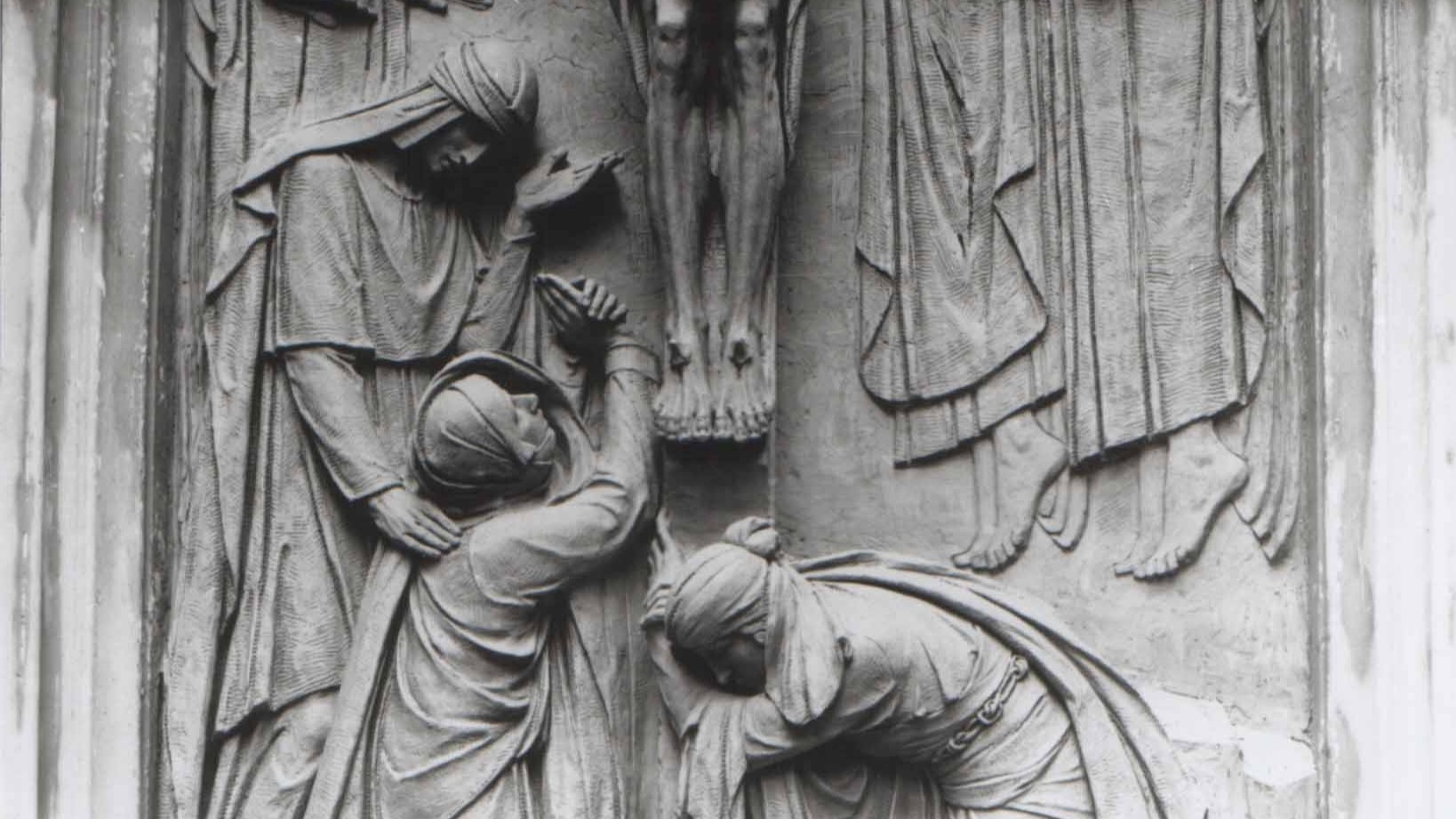
Today, as we place ourselves at the foot of the cross beside Mary the mother of Jesus, Mary of Magdala, John the Beloved Disciple, and Mary the wife of Clopas, may we look to the cross itself and seek the One who, in the words of Isaiah, “was wounded for our transgressions, crushed for our iniquities; upon whom was the punishment that made us whole, and by whose bruises we are healed.”9 The One who we die with is the same One we are raised with—Jesus of Nazareth, who said “I am he.” Indeed, he is. Amen.
This text is of a reflection I wrote and preached for Good Friday 2025, with the scriptural passages set out by the Revised Common Lectionary.
The scriptural passages assigned to Good Friday by the Revised Common Lectionary are Isaiah 52:13-53:12, Hebrews 10:16-25, John 18:1-19:42, and Psalm 22.
For more information on the Lectionary, visit Lectionary Page for the cycle of scriptural readings for Sundays, feasts, and seasons in accordance with the Revised Common Lectionary and its use in the Episcopal Church.
- Jn 18:4 (New Revised Standard Version) ↩︎
- Ibid. ↩︎
- Ibid. ↩︎
- Jn 18:5-6, 8 (NRSV) ↩︎
- Mk 10:36 (NRSV) ↩︎
- Mt 16:15 (NRSV) ↩︎
- Various renderings/translations of Jn 18:4 from the following bible translations, listed in order of appearance: Holman Christian Standard Bible (CSB), English Standard Version (ESV), The Message (TM), and the New International Version (NIV) ↩︎
- Heb 13:8 (NRSV) ↩︎
- Is 53:5 (NRSV) ↩︎
 John Lee Wagas

Leave a comment