Virtue is often seen as something incredibly lofty—an unattainable standard which one can merely aspire to. As distant as virtue may seem, it is indeed achievable. Doubt it? I do too. But take Aristotle’s words to heart when he beckons us to realize that virtue is not only possible but practical.
To live a virtuous life is to thrust the entirety of oneself into a lifelong endeavor, entailing rearrangement and transformation. Yet I believe that, in developing virtue, a person must not only engage community as called for by Aristotle, but also allow themselves to embrace the discomfort that inevitably comes with encounter.
By embracing discomfort, I believe that we break free from the chains of our egos and abandon our personal echo-chambers, opening ourselves us to the true breadth and depth of the human experience.
Virtue 101
According to Aristotle, virtue involves, among other things, balancing all the aspects of one’s life No singular disposition, such as confidence, should overpower its counterpart—in this case, humility.
However, the lifelong quest to be virtuous entails far more than this. It also involves developing habits that build up one’s interior and exterior life, incorporating a positive mindset that affirms a person’s potential to develop themself, fostering their skills and talents, and engaging with others in community.
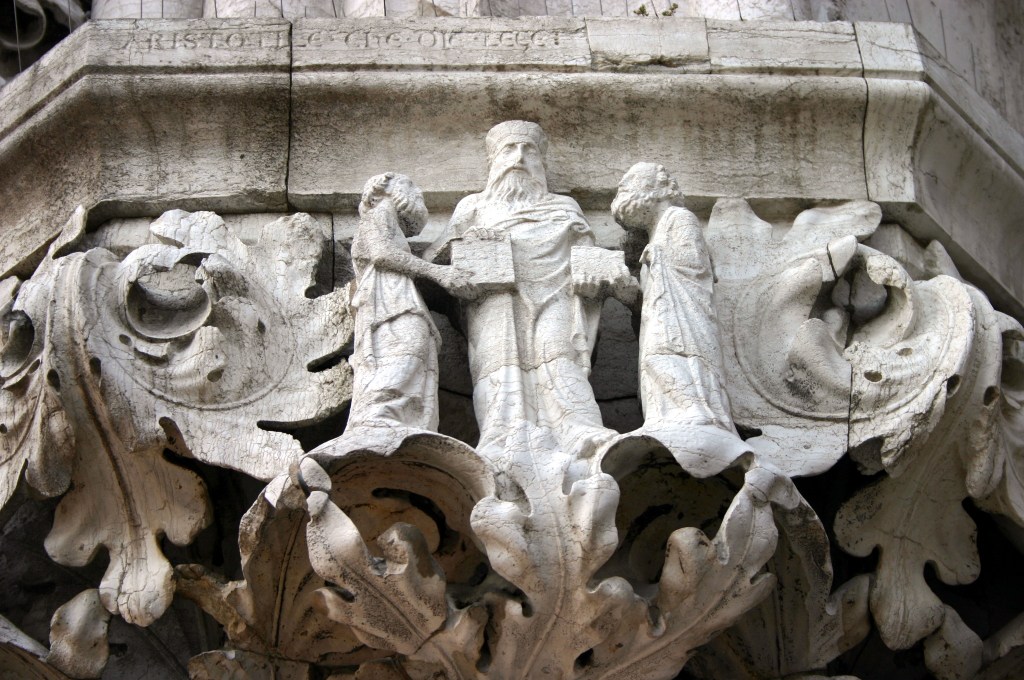
But what does the community have to do with virtue, if becoming virtuous seems to be a personal endeavor? Well, if virtue is about balance, then a balance must be struck in all aspects of our life and intricacies of our human nature. Therefore, a balance must be struck between one’s personal life and communal life—as aforementioned, one’s interior and exterior life.
The virtues [moral excellence] therefore are engendered in us neither by nature nor yet in violation of nature; nature gives us the capacity to receive them, and this capacity is brought to maturity by habit.
Aristotle | The Nicomachean Ethics
As humans, we are inherently inclined to socialize and gather. We seek to be among others, form relationships, and establish communities. The call to community is to go beyond ourselves in humility and compassion. It is the movement from “I” to “we.”
I believe that it is not only the broad concept of community that matters to building virtue; it is also about encounter. The meeting of two people, the convergence of two lives, the intersection of once-separate existences that, whether by fate or chance, come into contact.
To me, The Hobbit, written by J.R.R. Tolkien, is the perfect tool to better understand the intersection of virtue, community, encounter, and disruption. It is not my intention to dive a thorough summary of the book, but to point out three particular events across the novel’s span, with Bilbo Baggins as our guide, to better help us visualize the movement from “I” to “we” in the context of Aristotle’s discussion of virtue.
An Unexpected Adventure
In a hole in the ground there lived a hobbit. Not a nasty, dirty, wet hole, filled with the ends of worms and an oozy smell, nor yet a dry, bare, sandy hole, with nothing in it to sit down on or to eat: it was a hobbit-hole, and that means comfort.
J.R.R. Tolkien | The Hobbit, or There and Back Again
At the heart of Bilbo’s journey is encounter, defined by Oxford Languages as “an unexpected or casual meeting with someone or something.”
His journey begins with an encounter when, on a quiet morning, Bilbo is greeted on his front porch by Gandalf, who inquires about his day and states his intentions—to find someone to share in an adventure with him. Bilbo incessantly says no but ultimately gives in.

The following day, Bilbo encounters the company of dwarves, too many to name and all of varying extents of relations, but are led by Thorin Oakensheild, the heir to the lost Kingdom of Erebor—now occupied by the dragon Smaug. The dwarves show up either alone, in pairs, or in clustered sets, all disturbing Bilbo’s evening peace as he attempts to have dinner. As courteous as he tries to be, he is increasingly irate and thrown off guard by each new knock at the door and dwarf that steps into his abode.
Later on his journey, Bilbo, as he escapes a cave kingdom of goblins, parts from the dwarves and is lost in a cave system. After finding a mysterious ring, he soon encounters Gollum, a hobbit now corrupted both physically and mentally due to his possession of the Ring of Power forged by Sauron. Engaging in a battle of wit and riddle to escape Gollum and the cave, Bilbo eventually wins and sneaks off with the ring, Gollum’s “precious.”
Necessary Encounter, Beautiful Disruption
The common vein that runs through each of these particular events in the novel is unexpected interaction—the essence of encounter. However uncomfortable these experiences were for Bilbo, none of them were ultimately detrimental to his wellbeing. On the contrary, they all led to a positive and radical transformation.
With Gandalf, Bilbo learns to no longer fear the unexpected and now dares to take risks. With the Dwarves, he learns to not isolate himself from others in fear of being annoyed, instead becoming understanding and caring. And with Gollum, he abandons his disregard for the wellbeing of others and, when faced with the choice to kill Gollum or not before fleeing the cave, becomes merciful and spares the life of the wretched creature.
He remains very much himself when he returns to the Shire, but much has also changed. Bilbo finally achieves balance, just as Aristotle desires us all to do. He appreciates isolation and time to himself while also enjoying the company of Gandalf and the dwarves. He cherishes the safety of his hobbit-hole while at the same time is not afraid to set out into the beyond and journey through Middle-earth. He loves the comfort of the Shire and the peace that it brings him, but does not shy away from setting out and traveling across Middle-earth.

The full title of the book is The Hobbit, or There and Back Again. Is this subtitle not rightfully fitting in light of the plot points we have reflected on? Bilbo indeed travels “there” to the lost Dwarven kingdom of Erebor and comes “back” to the Shire. But there is a point behind these distinctions. For us, they are points of comparison that we can use to mark the stages of transformation that Bilbo undergoes throughout the book.
Once an isolationist, Bilbo’s journey transforms him into someone who is open to the world. Something already within him, once subdued and hidden, was stirred up and, by the end of the novel, had broke free in its glory and complexity.
No [person] is an island,
John Donne | No Man Is An Island
Entire of itself,
Every [person] is a piece of the continent,
A part of the main.
Encounter is often an interaction that isn’t just merely a meeting, but is abrupt, unexpected, startling, & even unsettling. But isn’t that what we need? Don’t we need to disorient and unsettle ourselves a little in order to achieve balance? Maybe we need to disrupt the normality, familiarity, and routines of our lives in order for us to grow—digging holes across a once-untouched landscape to allow the cultivation of new life.
To that end, don’t isolate yourself from the world, being content as you are. The call to virtue is a call to see the world as it is, to see people as they are and meet them where they are, and to be humble enough to see ourselves as we are—in order for us to be transformed.
Community isn’t simply being associated with a wider group of people or living in a populated area; community, among other things, means encounter.
Encounter means that we meet the unexpected face-to-face, interacting with our surroundings and making ourselves open to others.
In meeting others, we meet ourselves, and in learning about others, we learn about ourselves. So be like Bilbo—recognizing that within each of us is not only immense untapped potential but existing gifts, that we need community to grow as individuals, that the unpredictability of encounter ultimately enriches our lives, and that a little disruption and discomfort may not be so bad in the end.
The text of this post is adapted from a presentation I gave for the course Introduction to the Humanities.
 John Lee Wagas

.jpg)
Leave a comment