Omnipotent. Omniscient. Omnipresent.
These omnis are terms used to articulate the attributes of God. While these may serve as means of better understanding God and fostering a deeper relationship with Godself to some, I find myself often feeling alienated and distant from the divine because of these terms. Related terms such as immutable and aren’t any more helpful or consoling either.
Often their technical language that borders on the over-philosophizing of the sacred that causes me to feel distant from God. While I myself am an armchair philosopher and therefore have a propensity to enjoy indulging in complex texts incorporating dense language, as a theist—and a Christian, more precisely—God for me transcends words and thought itself.
While characterizing God with philosophical language such as non-being helps respond to the question “Who created the Creator?” by stating that God is a being beyond, rather than among, beings so as to be placed beyond the confines of finitude and corporeality (see Aquinas’ Argument from Contingency for further articulation), such dense language depersonalizes God to the point where one is likely to question why bother fostering relationship with a divine. If God is so mighty, powerful, invincible, and glorious, why bother trying to become close to such a God. And why would God even bother with me anyway?
Desiring a Weak God
I want a God who is weak. I want a God who is vulnerable, who suffers with us—along side us—and not just for us or in our place as a ransom (I’m talking to you, Anselm). I want a God who is weak—weak in the sense that Godself is not afraid to eschew divine invulnerability and almightiness in favor of fragility.
Indeed, don’t we need a God who is weak. Don’t we, as humans in all of our mortality and fragility, need a God who not only knows but shares in our pain. If our God-talk only focuses on the mighty news and glory of the divine, the what point is there to stress having a “personal relationship” with such a God?
This is not to say that we need a God who is utterly weak; we need a God who, at moments, allows Godself to be weakened in such profound ways that they are not gimmicks or ponderings but a genuine act by the divine intended to dwell in solidarity with creation. For do we not only need a God who dwells above, behind, and around us but also in the midst of us?
As it is prayed in Saint Patrick’s Breastplate,
Christ with me, Christ before me,
Amen.
Christ behind me, Christ within me,
Christ beneath me, Christ above me,
Christ at my right, Christ at my left…
The Cross as the Weakening of God
Friends, I have gospel—good news: we indeed have such a God, a God who is weak. Our God is not merely a God of Christmas (Incarnation) or of Easter (Glory and Victory), but also of Good Friday and Holy Saturday (Weakness, Vulnerability, Fragility, and Death).
The literal death of God in the person of Jesus—the second person of the Trinity— involves the destabilization, weakening, and disruption alongside psychological elements including trauma, anxiety, scorn, alienation, and persecution as well as physical elements such as pain and suffering.
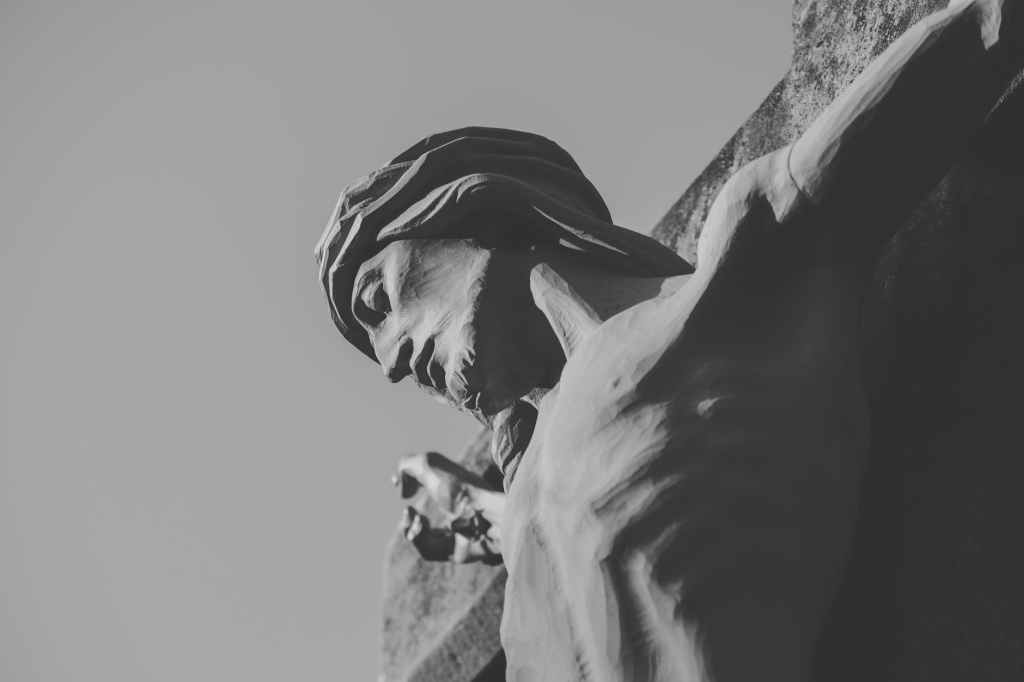
In contrast to the classical and rational gods of the Greeks and Romans who were immortal and competitors with humanity, the G-d of Christianity in the person of Jesus allowed G-dself to not only be vulnerable to scorn and shame, but to suffer alongside humanity as a criminal, rebel, victim, and martyr. In the event of Christ’s death on the cross, G-d abandoned all immortality, impenetrability, immunity, and transcendence in order to engage in the utmost intimacy of humanity, even at the expense of G-d allowing G-dself to no longer be utterly transcendent and untouchable.
The G-d of Christianity in the person of Jesus allowed
G-dself to not only be vulnerable to scorn and shame, but to suffer alongside humanity as a criminal, rebel, victim, and martyr.
It is by the drama of Jesus’ passion—spanning his betrayal by Judas to his Descent—that God became vulnerable to the evil aforementioned powers that plague humanity: persecution, scorn, isolation, trauma, and suffering. In this way, Christ is truly “with us” and “within us,” both “beneath” and “above us.”
In a way, the cross of Christ is the ultimate stooping of God, in which God allowed Godself to be persecuted, hated, and victimized. As it is sung in the hymn “Draw Near and Take the Body of the Lord,” Jesus allowed Himself to be “victim and…priest.” In other words, God remained utterly paradoxical—ever close yet ever near, ever personal yet ever transcendent, ever impenetrable yet ever vulnerable. In the end, it is by this paradox and the utter weakening of God that creation has, in the language of Isaiah and Peter, been healed.
 John Lee Wagas
Leave a comment